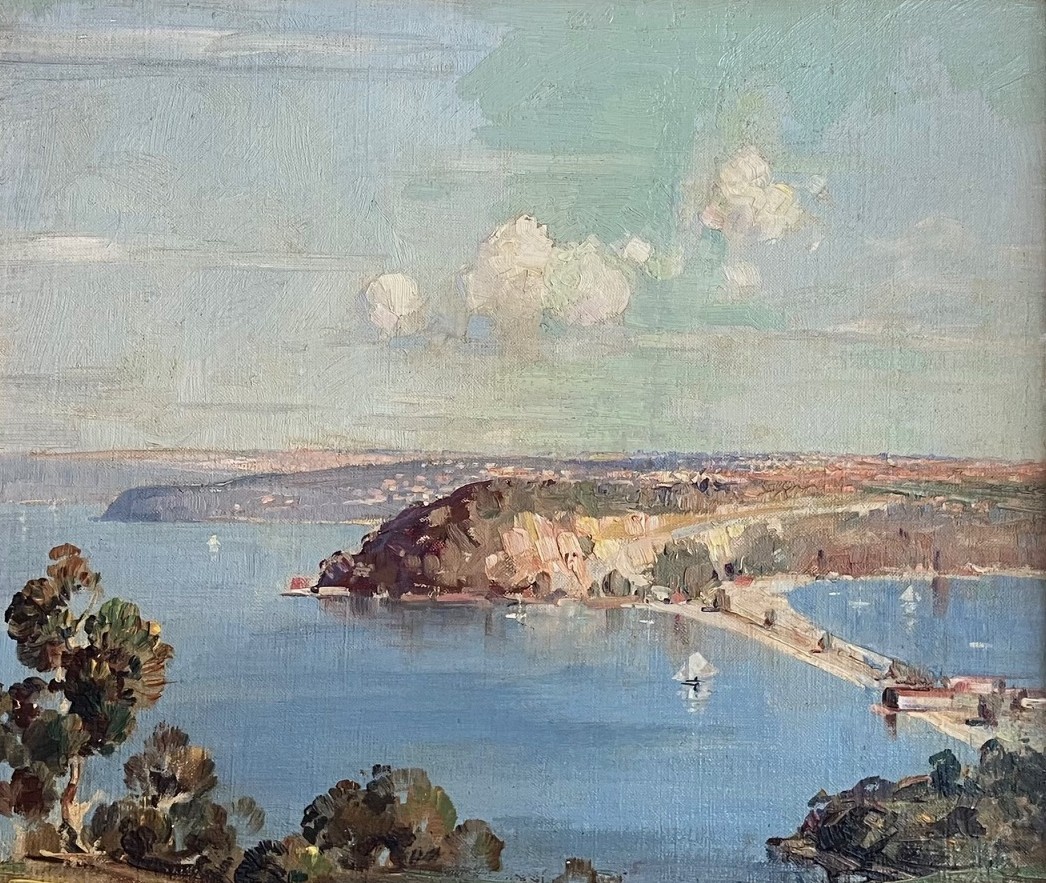
Painted from the high vantage point provided by the hills above Clontarf, looking south-east towards Mosman and the city, Sydney Long’s The Spit, Middle Harbour, Sydney (1930) offers a glittering, sweeping view of the narrow sandbar connecting the Mosman peninsula to the Northern Beaches, a transport axis that would undergo rapid change throughout the twentieth century. One of the loveliest aspects of the scenery around Sydney, the foreshores of Middle Harbour, ringed by beaches and sandstone bluffs, were often painted alongside rural subjects between the wars, each representing a land of plenty “where peace and sanity prevailed.”¹
Sydney Long had a long-standing connection with the Mosman area, dating back to his early days painting with fellow Impressionists Arthur Streeton, Tom Roberts and Julian Rossi Ashton at artists’ camps in Sirius Cove and Edwards Beach. In 1925, Long returned from fifteen years in London. During this time, he had become an accomplished printmaker, and upon returning to Sydney he founded a school of etching on George Street, which operated until 1944. Although etching occupied much of his artistic practice during the interwar years, he continued to paint landscapes. Living in Willoughby and Greenwich, Long frequently used the newly built timber Spit Bridge to access his weekend caravan at Narrabeen, which became the subject of many of his late landscape paintings.² Although a crucial addition to the city’s infrastructure, the first wooden bridge over The Spit, completed in 1925, has been cropped from Long’s composition, extending beyond the frame. Along with the steep section of Military Road climbing the hill and the buildings of Mosman, the built elements of the view have been minimised and subordinated to the broader expression of natural beauty, appearing only as subtle dashes and generalised sweeps of oil paint.
Displaying the same qualities that Arthur Streeton described as “simple and full brushwork” and a “purity of colour,” Long’s view of The Spit is painted with confidence in the radiant hues characteristic of the Sydney landscape.³ Using a square-tipped brush, the golden cliffs of Parriwi Park glow in the sunlight, while bright white clouds scud across a clear blue sky above the low horizon. Although it no longer contains the poetic flights of fancy found in his early Symbolist watercolours, Long’s decorative and romantic late landscapes were warmly received by both the public and the conservative art establishment.
¹ Hoorn, J., ‘Misogyny and Modernist Painting in Australia: How Male Critics Made Modernism Their Own’, Journal of Australian Studies, no. 32, 1992, p. 7.
² Gray, A., Sydney Long: Spirit of the Land, National Gallery of Australia, Canberra, 2012, p. 33.
³ Streeton, A., ‘Paintings by Sydney Long’, The Argus, Melbourne, 13 October 1931, p. 9.
Text by Lucy Reeves-Smith